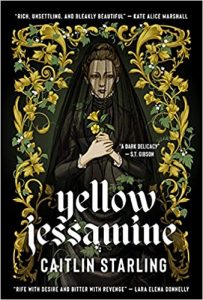
Caitlin Starling’s Yellow Jessamine is the novella to reach for on a dreary day. It was gray and rainy in late October when I read it, so the setting was perfect. Starling’s novella is a thoroughly gothic horror with light sapphic undertones, so if the yearning™ isn’t your thing, this may not be the title for you.
The novella is under 150 pages, making it a scrumptiously atmospheric treat, easy to consume in a single sitting. Reading Yellow Jessamine only confirmed Starling’s insta-buy status for me. She’s an expert at cultivating a sense of indefinable, creeping dread, and I am utterly insatiable when it comes to the uncanny. Spooky isn’t the right word for Yellow Jessamine, because that lacks the gravitas this novella deserves. It was… horrifying, strange, and unsettling. It takes up an outsized amount of space in my brain. I think about it often and worry at it.
Readers, we open in the dying, rotting city of Delphinium, a lone holdout in an empire broken by a military coup. Lady Evelyn Perdanu, dressed in her perpetual mourning black, veiled face and all, watches a ship out in the harbor burn and burn.
Heir to a wealthy shipping company by way of being her family’s only survivor, the unmarried Lady Perdanu is duly alarmed by the sight of the burning ship. She soon discovers it’s the result of an unknown illness: a plague that plunges its sufferers into a catatonic state. We follow Lady Perdanu’s slow unraveling of the mystery sickness that hollows out its victims and leaves them unblinking shells. Of course, Lady Perdanu couldn’t do any of this without her steadfast and loyal assistant, Violetta Fusain. Insert sapphic longing here.
Published during the heart of the COVID-19 pandemic in September 2020, Yellow Jessamine’s opening reflects the time period: a mysterious sickness and a familiar rising panic. Reading a distorted mirror of that experience was deeply uncomfortable in a way that I appreciated from a horror tale. While the novella’s deliberate pacing was occasionally ponderous, ultimately this helped build the sense of foreboding, so much so that it made it hard to look away. I was entranced by the terrifying and continually developing illness, which grows ever closer to Lady Perdanu and Violetta.
One critique I read was that others would have liked more worldbuilding, but this wasn’t a concern for me. Then again, I don’t need a great deal of scaffolding—sketch the rough outline and I’ll fill in my own details, for better or worse. This strikes me as a personal preference rather than a flaw in the novella, and it made sense to me that the pages were spent elsewhere, given that there were only ~130 of them.
Yellow Jessamine has my wholehearted recommendation. If you want to be enraptured, if you want to spend time with someone struggling and probably more miserable than you, go get you a copy. Lady Evelyn Perdanu wasn’t kind, but she was raw and real, and if I were backed into a corner, I’d be a lot more like her than I want to admit. It’s a rare gift to be able to encapsulate this level of unease in a morsel, but Starling pulled it off and then some, weaving a frightening tale with delicious prose.
Content warnings: Gore, death, murder, pandemic
Susanne Salehi (she/they) is an Iranian American writer and editor who writes queer heroes. They are a 2025-2026 Poetry Coalition fellow and a 2025 Lambda Literary Emerging LGBTQ Voices fellow. Her work appears in Fruitslice, Frazzled Lit, and the anthologies By Her Sword and Nearest and Dearest (forthcoming). They hold an MA in medical anthropology and are finishing their MFA at Emerson College alongside their first novel. She also collects silly tattoos—Frog & Toad and the screaming possum are her favs. More at www.susannesalehi.com.



Leave a Reply