Buy this from Bookshop.org to support local bookstores and the Lesbrary!
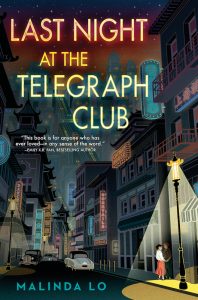
Malinda Lo’s novel Last Night at the Telegraph Club (2021) has won multiple awards and has been reviewed multiple times at the Lesbrary already, so let’s start this review somewhere different: Last Night at the Telegraph Club has been banned and/or challenged at least 34 times in 14 states. Having done a bit of research and writing about these book challenges, I’m going to let you in on a little secret: the people who submit complaints to school boards and file police reports with law enforcement very rarely actually read the books that they are attempting to ban. In the post linked above, Lo provides evidence of just how easy it is to file FOIA (Freedom of Information Act) requests that reveal all sorts of information about the people who want to ban books that they feel do not fit a certain narrative profile.
This is why you won’t see me write much about YA here—I spend way too much time writing about these issues elsewhere. However, I wanted to write about Last Night at the Telegraph Club because, simply, I hadn’t read it yet. 2023 was not a good year, so why not end it with a book on my TBR pile that I knew would be good? And it certainly was.
One element of YA that is important to watch out for is how it serves two primary sets of readers. The first set is the group of readers whose identities most closely align with the characters and/or the subject matter. For example, in the case of Last Night, adolescents who are Asian American, immigrants, and/or part of the LGBTQ+ community are in this first set of readers (along with potentially any other adolescent from a marginalized community). When we talk about who books are for, this is the set of readers to whom we are usually referring. If I can recognize myself in some facet of Lily’s character, Last Night speaks to me and my experiences. I might, for example, be reminded of the thrill of realizing something important about myself when Lily begins to interact with Kath, or I might recognize the danger that I feel through Lily’s constant need to keep large parts of her life a secret. In other words, the reader’s experience is reflected back to them in the pages of the novel.
The second group of readers is, simply put, everyone else—and this is where we run into trouble. Why should my child, who is nothing like the characters in these books, be subjected to these books? That’s the question that I’ve heard posed so often, either in those exact words or otherwise. Their children, they argue, shouldn’t have to be confronted with what it means to call an Asian American person a term that is meant to describe objects rather than people. Their children shouldn’t be exposed to a point of view that challenges the way the “typical” white person behaves, as they are when Lily is asked if she can speak English or is repeatedly called a “China doll.” Their children, most especially, shouldn’t see “immoral” behavior go unpunished.
Except these sorts of issues are precisely what adolescents should be reading about because, for many, novels like Last Night provide a window into an experience that isn’t their own. The parents who seek to ban books only want their children reading books that mirror a certain set of experiences, while marginalized adolescents have to look through windows into lives that don’t mirror their own. In truth, all adolescents should read both sorts of books. All adolescents need the books they read to function as windows and mirrors so that they can learn about themselves and about others. (Note: The credit for the windows/mirrors metaphor goes to Rudine Sims Bishop, who advocated for diversity in children’s literature, particularly for Black readers and authors. Here is a great resource for more on this concept.)
Again, I really enjoyed Last Night, and I wanted to say just a bit more about two things that I found particularly delightful: the discussions of butch/femme and signaling. Does anyone remember Genesis from The Real World: Boston? The first time that I ever heard the term “lipstick lesbian” was from her. A couple of years later, I learned more about the concept of “butch” from Jack Halberstam. In 2024, we know that these terms are slippery and have limited utility—perhaps they don’t even have any utility for current adolescents at all. However, for many of us who left adolescence behind long ago, femme and butch were part of the limited ways that we had to describe queerness at something resembling a mainstream level.
Lo uses the historical setting of San Francisco during the Red Scare to explore the femme/butch binary in a way that helps younger readers understand the ways in which previous generations explored queerness, sexual orientation, and gender expression. Again, even if the femme/butch binary doesn’t serve adolescents today, the historical context does because, as we know, where we came from directly influences where we are and where we are going. And, of course, who among us hasn’t at some point felt the same awkwardness and excitement that Lily feels as she is figuring all of these things out over the course of the novel?
This past fall, I taught an undergraduate seminar on young adult literature; in one of the books that we read, several characters provide nonverbal cues to signal their sexuality. The discussion that we had in class about signaling was one of my favorite discussions that we had all semester. I wish I had time to recount more of that discussion; for now, though, just imagine Last Night as a way to juxtapose mid-20th century signaling from what it looks like today. After all, all one has to do today is slap on a pride flag, get an undercut, or quote Steven Universe or The Owl House, and the people who need to know—well, they know. Compare those contemporary signals with the ways in which Lo describes the way her characters dress and wear their hair as well as the way she describes Lily’s reverence as she encounters outward expressions of queerness.
If you haven’t read Last Night at the Telegraph Club yet, don’t wait any longer! If you have read it already, perhaps it’s time to give it a second read.
Content warning: homophobia, racial slurs, racism
Liv (she/her) is a trans woman, a professor of English, and a reluctant Southerner. Described (charitably) as passionate and strong-willed, she loves to talk (and talk) about popular culture, queer theory, utopias, time travel, and any other topic that she has magpied over the years. You can find her on storygraph and letterboxd @livvalentine.