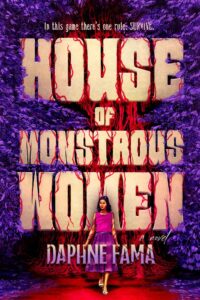
House of Monstrous Women is Daphne Fama’s stunning debut novel out August 12, where, “a young woman is drawn into a dangerous game after being invited to the mazelike home of her childhood friend, a rumored witch, in this gothic horror set in 1986 Philippines.” I found it as deeply unsettling as it was tender, and I’m already excited for her next novel.
Daphne graciously agreed to a virtual interview, where she shared her incisive perspective on House of Monstrous Women. She was as kind and thoughtful as the book led me to believe. The following interview was edited for clarity and length.
Susanne Salehi: Do you have a formative novel? One that shaped you, in some way, to be the writer you are today?
Absolutely. Like so many horror babies, I started with Scary Stories to Tell in the Dark. The smudged and almost surreal illustrations left a permanent mark on my brain and started a lifelong love for the genre.
From there, I really latched onto novels like The Shining, Hell House, and of course Mexican Gothic. Sprawling houses full of dark corners and darker secrets spoke to me in a way I couldn’t shake. Suffice it to say, they left their fingerprints all over House of Monstrous Women.
What do you love to read?
It’s not a surprise that I love horror. And I particularly love it when there’s a little bit of cannibalism involved. Is that strange to say? But 2025 is definitely the year of cannibalism and I’m all about it.
I’m also really enjoying horror novels that try new things, like Nick Medina’s The Whistler, which comes out in September. I had the pleasure of reading it early, and it features a very flawed, disabled protagonist and some very interesting Native American folklore elements.
Can you share a little more about your inspirations for House of Monstrous Women?
Honestly, a lot of it is my upbringing. My mom had a friend that belonged to a family people believed were aswang. Growing up, my family told me about their own experiences with sigbin and duwende. From there, it was an easy leap to Filipino witchcraft.
But it’s not an easy topic to research or find people to talk about it with. I’m honestly devastated that everything precolonial in the Philippines is vanishing. Modernization and globalization has it all fading so fast. Even the older people in Carigara—like my grandparents—don’t know a lot of this stuff. It’s already forgotten.
For House of Monstrous Women, I spoke to people and collected as much about Filipino witchcraft as I could. Then, I poured as much of that as I could into the book. I also had a strong desire to create a living testament to this craft that would otherwise be forgotten.
As for the darker elements, I put everything I was really scared of into House of Monstrous Women. One of the big ones is the loss of agency, exemplified by Josephine losing her sense of self and integrity, and in aspects of her body as a sacrifice. I also was fascinated by slaughterhouses, the way that a living organism can be reduced into a product for consumption. It’s a commonplace horror that we don’t acknowledge, but if we saw how the sausage was made, I think we’d all lose our appetites pretty quickly.
How do you think House of Monstrous Women speaks to the present moment (since it’s set almost 40 years ago)?
Well, it’s set in the backdrop of the People Power Revolution, which is really important to me.
Yes! These nonviolent demonstrations—2.5 million strong!—ended 20 years of Ferdinand Marcos’s dictatorship. Absolutely incredible. I can’t believe I just learned about it just now, through your book.
I’m so glad to shed some light on it! My mother lived through it, and that thread connects to when I was in Manila when Duterte was campaigning. I was shocked that he had so much support. He was pro-Marcos, the Philippines’ equivalent of Trump. I don’t understand this huge pendulum swing—from the People Power Revolution, to the current policies. People loved Duterte because he campaigned on killing drug addicts. But why would you root for any group of people to die? They thought he would change the country through aggressive means, which I can’t help but compare to Trump and his “alligator Alcatraz.”
My book is a critique of the current political climate. How can we forget our history, especially when it’s so recent? It’s gotten worse everywhere, so it’s becoming more relevant. We are more disenfranchised. The only way we can save ourselves and right the course is to take power back as a people, as a community, as a country. The government will not roll over itself and do it for us.
Do you have a favorite part of the book? Was there any part that was really fun to write?
I really like the house, how it’s so sprawling and labyrinthian and how it has this layered memory of everyone who’s ever lived there. The house is almost like a graveyard of those who came before, but it’s very much alive. Other than that? It was all the scares! I liked writing about the servants and hunters giving chase. And the ending, how it got so fast paced and creepy. It was just fun to do.
[Spoiler question]: The house! I can’t believe I forgot about the house. What happens to it at the end?
The house rebuilds! It doesn’t die. It’s part of the tree, but it doesn’t matter if you burn it, it will come back. The Engkanto wants and wants… It will sometimes offer gifts, but there’s always a noose at the end of it. Its hunger will just find someone else to do its bidding. It will find someone else and the trap will be set again, but not for awhile. Some people may want a firm ending, like “evil is dead,” but I like that it’s still there.
It feels more true to real life.
Yes! You have to keep fighting.
Was there any part of the book that you struggled with?
Totally! At first, I couldn’t get into writing Josephine. I didn’t realize it at the time, but Josephine represented all of my unresolved issues with how I’d built my life. She was isolated and alone, stuck in a crumbling house she didn’t want to be in, getting swept along by others. And I felt similarly. I hadn’t really chosen my career path, I’d selected very heteronormative relationships. I didn’t feel any attraction, he’d become abusive, but he was the type of guy I was supposed to be with. I was moving along but miserable.
When Josephine makes her leap of faith into the house, it’s very dangerous and stupid—but it’s her choice. I did the same thing. I pursued my book, I left that relationship, I moved to a state I’d never been to before. That was my version of betting it all and managing to win the game.
Once I realized who Josephine was, it was much easier to empathize with her, to get her to move forward and give her the journey she needed.
Is there anything you had to cut that you wish had made it in?
Oh, yes. There’s the kitchen aspect. All the cannibalism was way more brutal before. Honestly, I was a little surprised my editor bought the book! But I don’t think House of Monstrous Women would have made it to market with all that in it. I poured every nightmare I ever had into this novel, but that doesn’t necessarily make for good reading.
Speaking of the kitchen, what’s the deal with the butcher? He felt like such a fully realized character.
He was there from the very beginning. He’s another Filipino mythic aspect, a busao, which is like the aswang, but is always male. In society, they masquerade as people. They hunger for corpses and are almost always butchers.
Through all the rewrites, he was always in the book, but I just couldn’t introduce a new folklore creature that far into the book. It was easier to put him under the aswang umbrella.
As for his role, if you asked Hiraya who the chef is, she would probably have no idea—she’s never seen him or thought about him. And he’s fine with that. He’s happy to just exist in his own kingdom of blood and meat. He puts his passion there; he’s a true chef, and he’s completely content. If the house rebuilds, you can bet he’ll be there, putting up the walls.
I really love this idea you’ve put out there with Hiraya, that you become a monster when you passively accept your fate and don’t choose for yourself. I’m obsessed with the concept of monsters and monstrosity, and who gets to decide who or what is monstrous. I’m also kind of obsessed with the fact that you are so tender towards Hiraya. You always show her humanity and kindness, even when the rest of the world doesn’t. I’m not really sure what the question is here, but I’d love to hear your take on monsters, and how this influenced the story you told.
Well! I know the book is called House of Monstrous Women but personally, I don’t think there are any monsters in the house. Every woman who lived there was born into circumstances that they were just trying to survive, using what little avenue they had.
Originally, Tadhana was in love with Josephine’s mother, and she sacrificed to give her her life, even if it was going to be cut short. That was her one act of freedom. After that, Tadhana was forced into conformity that drove her insane and made her complicit; the same thing happened to Sidapa, but Sidapa pushed back. She didn’t want the life the engkanto demanded she live. Sidapa refused to comply and was killed, sort of. She looks monstrous, but she’s not monstrous in any capacity. She’s a tragic figure. Hiraya was the same. She didn’t want to hurt anyone, although she had to as a part of the game.
It’s this coercion of circumstances that makes people perceive the Ranoco women as monsters. If you were in the same situation, well—I don’t think anyone would be righteous or good. If Josephine or Gabriella were in the position of the hunters, they’d have the potential to become monsters as well. It’s all about perception: whoever’s on the outside looking in decides who’s the monster.
Oh! Speaking of Tadhana. Could you share more about the sleep paralysis scene?
In her madness, she was reminded of the woman she loved, Josephine’s mother. She was trying to consume her and bring her close, but aswangs don’t eat the living. By attempting the cannibalistic act that she is forced to do endlessly, she’s trying to bring her loved one close. She gave everything for this love, by bringing her into her body. It’s a terribly monstrous thing, how an obsession, a refusal to let go, can twist you and hurt you.
What role does queerness play in House of Monstrous Women?
There are so many interpretations of queerness in Filipino history. The Philippines has always been very queer and very trans friendly. Transness is just accepted there. But of course, it’s very complicated. Filipino culture will accept that queer people exist and people won’t stop you from being queer, but you’re still sometimes forced into these performative relationships because it serves a purpose. Community there is so important, so it’s hard to refuse.
In the novel, everyone knows that Josephine loves Hiraya. It’s not a secret, but it’s also not important when it comes to making decisions about her future. It’s just assumed that she will marry someone she doesn’t love and that she’ll die in that loveless relationship. Hiraya knows her feelings about Josephine exactly, and she doesn’t care how people view that. It’s her refusal to care about what society thinks that puts her outside of social norms, and part of what makes her monstrous.
When you look at Tadhana, she exists in the older generational way, the Spanish way… The woman she’s in love with is likely stringing her along, and has always wanted to exist in society as a beautiful, high class woman. Tadhana exists so far outside that, that it was never really an option for Josephine’s mother. So Tadhana just suffered.
[Spoiler question]: I’m really impressed at the ingenuity and inventiveness of giving a truly gruesome horror novel a happy ending! What influenced your decision to do that?
Actually, there were two different endings. In my original ending, Josephine and Hiraya left the country. They went to Paris, got an apartment, where Hiraya leaned into being an aswang. She became more monstrous, while Josephine leaned into her passivity and became complicit in the darkness that Hiraya accepted for herself.
As my mental health improved, that changed. Eventually, I started to feel like I was going to get through my own dark time, and I was able to give Josephine the ending I think she deserved. I think I deserve that happiness, too. I built the book’s current ending around the idea that things will get better, that your friends and family will be there for you, and even if they pass on, they are still there for you. The love they had for you is still there.
Can you share your favorite thing that you learned from your research for this novel?
I had the most fun talking to people about it. I didn’t just talk to barangan and healers, I talked to lots of old folks as well. And they had so many weird stories! Did you know that aswangs have familiars? There’s this bird called a wakwak. When it’s close to you, its cry is barely a whisper, and when it’s far away, its cry is deafening. That’s how it tricks its prey. My uncle says he saw a sigbin, which is a dog that has its head where its tail should be. Apparently, one broke through our farm fence because we’d blocked its way to the river. We removed the fence!
There were a lot of stories like that, with little bits of creatures or people who went insane, where it’s thought that their insanity was based on engkanto or someone that could cast curses. For example, there was someone in Carigara who spoke things into being. If she said, “You’re beautiful,” then that person would lose their beauty somehow. She had to be careful about how she spoke. It was a restrictive way to live, all based on perception. But everyone accepted she had this ability. It’s so fascinating to me.
Is there any backstory or folklore you wanted to include in House of Monstrous Women but couldn’t?
Yes! The dolls with human hair came from someone who was trying to control the fate of the game by using poppets. There was Sidapa’s room of failed witchcraft, filled with amulets meant to be protective charms to keep back evil. Hiraya provided these to try and protect her, but they weren’t strong enough. What’s within the house is so much more powerful than the forces outside of it.
Mostly there was a lot more Filipino witchcraft I wanted to include, like hilo, which is a type of poisoning. You can speak poison into a person if you’re talented. Or, you can put it beneath someone’s bed, or you can touch their plate and poison them that way. Ultimately, that was replaced by insects. Sorcery is so much more complex than I was able to depict in the book. There wasn’t enough space to really dive into that, but I would have liked to.
Is there a core message you want readers to take from House of Monstrous Women?
When you first come into the book, it feels heavy and like life is set. Things are awful and they’ll never really improve. Alejandro felt that way about his circumstances. He couldn’t see how things could change for the better. In reality, that’s not true.
Things can change, but you have to take action. You have to make it happen. You can’t sit and passively wait for things to get better.
My focus was on Josephine’s journey—from being passive in her own life, to shaping her future, even if she had to sacrifice tremendously to do that. My mother supported the People Power Revolution, she made it known that the people wanted change, even if it was dangerous for her. I’m proud of her and everyone who took part. So that’s my message. If we keep fighting against the dark, eventually we will come out on the other side.
You’ve talked about growing up in an immigrant household and how for you, it came with the pressure to succeed in traditional ways. Can you share more about that?
Oh, it’s very relevant. Josephine had the opportunity to be educated, but it didn’t matter. It was just there to help you find a good partner. Similarly, I don’t think my mother cared that I was a lawyer. I think she wanted me to marry and live well, which she saw as the thing that would save me from the deep poverty that she experienced in her youth. I know that my mother thought the choices she offered me were the kindest possible, based on her own life experiences. But it’s different when you’re born here. You have so many more options.
Sometimes I feel guilty for not going along with the plans my mother had for me as elegantly as she might have wanted. But doing that destroys your soul. It eats away at you with each passing year. And I just couldn’t do it anymore. I think that’s something unique to the experience of being raised in an immigrant household, that overwhelming sense of guilt, that so much was given up for you to have this life. But even though I’m not living in the two-story suburban house my mother might have wanted for me, there’s joy.
Can you share about your writing process?
I burnt the candle at both ends for a really long time. You know the legend of Sisyphus, where he pushes the rock up the hill over and over? It’s like that. When you get your first draft, you’re so proud of it! But that isn’t the end, you have to keep going. I was working weekends, working nights, working at the expense of hobbies. There were events I would casually go to that got pushed to the wayside. I don’t regret it! It was extremely cathartic, and I achieved a lifelong dream, but it was hard.
This is an incredibly exciting debut! This reader would love to know what’s next.
And I’d love to tell you! Currently, I’m working on a novel I’m pitching as “Midsommar meets Filipino shamanism” with lots of cutthroat family drama. Hopefully it will come out next year. It’s in revisions now, so we’ll see.
Can you tell us anything else about it?
It’s definitely a high stakes situation, and it involves a Diwata, a deity of the town and the fields. Of course, it’s a horror novel, so things go horribly wrong from jump, and they stay horribly wrong. It’s nice to do a new take on this mythology, and nice to do it in a town, because it gives me more people to torment. I’m very excited about it.
Where can readers find you?
I’m now on Instagram at @daphnefamawrites because of this book. It’s still new, but I post a lot about the book. I’m also on Bluesky. You can also check out my website, www.daphnefama.com.
Any final words for readers?
I’ve heard a lot of people say that House of Monstrous Women is a slow burn. While I agree, please give it a try until about 50%, and then it gets much faster! (laughs) As for me, I’m grateful people are reading it. I appreciate that you’re just reading the title! Thank you so much.
Susanne Salehi (she/they) is a queer Iranian American writer and editor happiest when reading, cross stitching, gardening, or accumulating silly tattoos—they’re particularly proud of the screaming possum. They’re a 2025 fellow of the Lambda Literary Writers Retreat for Emerging LGBTQ Voices & they write queer heroes. More at susannesalehi.com.