Amazon Affiliate Link | Bookshop.org Affiliate Link
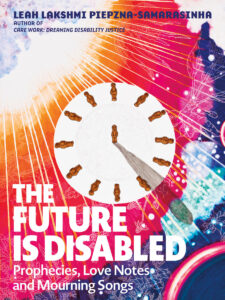
Leah Lakshmi Piepzna-Samarasinha is the author of two of my favourite books: Bodymap, a collection of poetry; and Care Work, a collection of essays about disability justice. So it’s no surprise that I loved their new essay collection about disability justice during the pandemic and in the future.
This book is written for a queer, BIPOC, neurodivergent, disabled audience, which is also the focus of disability justice. Not only does Piepzna-Samarasinha discuss their experiences as a queer femme disabled person of colour, but in this collection, she also writes about recently realizing they’re autistic and how that interweaves through those experiences.
The title of this collection is a reference to Alice Wong’s “Crip Oracle” (I just read Wong’s memoir, Year of the Tiger, and I also highly recommend it). The book explains that disabled people have been denied visions of the future. Not just the sci-fi future, but imaginings of adulthood, old age, and future possibilities. At the same time, we’re living through pandemics of COVID-19, racism, and a climate crisis that have become a mass-disabling event. With Long Covid and other consequences of these pandemics, it’s a real possibility that disabled people will be the majority in the near future, especially with more people embracing the labels of disabled and neurodivergent. Piepzna-Samarasinha asks, “Have we ever imagined this not just as a cautionary tale or scary story, but as a dream?”
These essays, written from 2020 to 2022, discuss what the pandemic has been like for disabled people. They talk about how many friends and role models in disability justice have died in such a short time span, and the grief they are holding. In one passage, an ICU nurse friend explained that she appreciated spending time with someone else who had been through a death Covid. Not a boredom Covid or an art Covid or a productivity Covid.
Piepzna-Samarasinha talks about ICU-genics, about disabled people keeping each other alive through the pandemic through networks of support and information. In one memorable passage, an organization recommended creating a one-pager about your life to hang around your neck when going into the hospital to try to convince doctors your life is worth saving. It would have a flattering picture of yourself and a few words about what you love about your life.
These essays also argue that disabled ways of thinking and working are crucial in addressing the enormous problems we have right now. Mutual aid saw new prominence during the pandemic, but some of the organizations that popped up in that time missed the mark and could learn from the disability justice groups that have been doing it for much longer.
Piepzna-Samarasinha isn’t afraid to wade into the real, messy process of creating care networks and working towards disability justice. They talk about the difficult questions and the problems that come up, as well as the variety of ways care and disability justice can look. She says that disabled community isn’t something you find, it’s something you build.
I took so many notes while reading this that I could keep spouting off bullet points of what I think is powerful and essential from The Future is Disabled, but it would be a very long review and would not be as good as just reading it. I always get so much out of Piepzna-Samarasinha’s books, and I’m looking forward to rereading it to get even more.
This book both faces the deadly ableism of the world we live in head on while also imagining a hopeful future, one partly made up of already existing spaces, like disability justice art performances.
I can’t recommend this book highly enough. Every book I’ve read about disability justice has expanded my mind and made me see new possibilities for the world and the way I live in it, and I know I’ve only scraped the surface of the wisdom and collective knowledge of this movement.