• Home
  • Browse by…
    • Browse by Genre
      • Children’s
      • Comics
        • Manga
      • General Fiction
        • Adventure
        • Anthologies
        • Crime
        • Fairy Tales
        • Lesbian Pulp Fiction
        • Literary Fiction
        • Novellas
        • Retellings
        • Series
        • Short Stories
        • Thrillers
      • Historical Fiction
        • 1920s
        • Regency
      • Horror
        • Vampires
        • Zombies
      • Mystery
      • Memoirs
      • Nonfiction
        • Biographies
        • Essays
        • History
      • Poetry
      • Romance
        • Butch/Femme
      • Erotica
        • BDSM
      • SFF
        • Sci Fi
          • Dystopia
        • Fantasy
          • Mythical Creatures
            • Mermaids
            • Witches
          • Paranormal
          • Steampunk
          • Urban Fantasy
      • Young Adult
    • Browse by Rating
      • 5 Stars
      • 4 Stars
      • 3 Stars
      • 2 Stars
      • 1 Star
    • Browse by Representation
      • POC Content
        • Main Characters of Color
        • Black Representation
        • Asian Representation
        • Latina Representation
        • Indigenous Representation
      • Authors of Color
        • Black Authors
        • Asian Authors
        • Latina Authors
        • Indigenous Authors
      • Lesbian Representation
        • Lesbian Authors
      • Bisexual Representation
        • Bisexual Authors
      • Trans Representation
        • Trans Authors
        • Nonbinary Representation
      • Asexual Representation
        • Asexual Authors
      • Disability Representation
      • Neurodiverse Representation
      • Mental Health
    • Browse by Reviewer
      • Danika Ellis
      • Alison Barker
      • Allie Greene
      • Amanda Růžičková
      • Caelin
      • Casey
      • Eileen Gonzalez
      • Emory Rose
      • Irene
      • Jamie Rose
      • Jazelle
      • Jessica Lee-Nadler
      • Kathleen Alys Hurley
      • Kim B.
      • Lexi McDonald
      • Lina
      • Lindzey
      • Liv
      • Melissa Marr
      • Phoebe
      • Rowan Graening
      • Sara Yates
      • Sritama Sen
      • Tessa L.
      • Til
      • Vic
  • Recommendations List
  • About
  • Review Policy
  • Support the Lesbrary
  • Advertise with the Lesbrary

The Lesbrary

Sapphic Book Reviews

Lesbrary Reviews

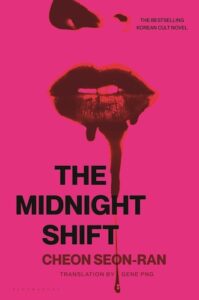
Vampires, Murder Mysteries, and Loneliness: The Midnight Shift by Seon-Ran Cheon, Translated by Gene Png

November 12, 2025 by Amanda Růžičková

The Midnight Shift cover

At its core, this is a book about the kind of loneliness that persists even in a life filled with relationships. I read it on honeymoon, almost a year late because of cancer treatments, and understood immediately what Cheon Seon-Ran’s vampires were hunting. That’s relevant because of what cancer ghosting taught me: you can be most alone with a contact list full of outgoing messages that have spent months on read, as if ‘Stage IV’ leaves you socially dead before you’re physically gone.

That’s the blood scent that Cheon’s vampires track in The Midnight Shift (originally titled 밤에 찾아오는 구원자, “the saviour who comes in the night”), sutured into English by Gene Png; structural erasure, not physical isolation. Laid out on that exam table, what could otherwise be merely Gothic decoration becomes a surgical social analysis. Png’s translation hands us the scalpel.

The Midnight Shift’s vampires can only be killed if they’re feeding upon the unwilling, so consent becomes the incision by which the book’s social surgery is performed. Cheon’s framing makes this predation a social failure rather than a supernatural threat. Her vampires don’t stalk those who are physically alone, as is so often the case; rather, they focus on the the socially exiled, like elderly people whose families stopped calling them or those in the queer community whose longing becomes its own kind of slow death “due to social judgement” (the author’s translated phrasing).

The 1980s France flashbacks, and a formative relationship they depict, don’t sentimentalise that; they show how queer intimacy and isolation wind together, and by doing so show how a resulting romance can be both a refuge as well its own peculiar abandonment.

The three narrative threads do occasionally snarl in their weaving. I’ll admit that one chapter lost me for a bit, causing me to backtrack to sort out which timeline I was following.

Png’s translation, on the other hand, rarely snagged on anything. I often forgot that I’m outside Korean literary traditions, except in rare moments where Png’s steady hand faltered and I felt the twinging of a Korean literary nerve I can’t name or touch. Those rare moments felt like overhearing snippets of conversation in a dialect I don’t speak, but a language I do… which definitely isn’t Korean, I assure you!

I don’t know how the book reads in its original context—what resonances it carries of Korean horror traditions or in what ways Korean readers catch particular notes of queerness differently than I can.

Here’s what I can see, though: the way that murder mystery mechanics are used to create a pressure that pushes characters into articulating their loneliness, and how all three narrative strands stay tangled up without one being made more important. Each of the central character has a different blood type to loneliness, and Cheon never makes any of them into a universal donor.

The author describes writing queer characters as being “simply familiar,” and connecting the loneliness of aging to the queer experience of loving “but not being able to be with them.” The book bleeds that connection through every page. The elderly patients whom the vampires target socially isolated by their age; queer desire isolates by social stigma.

Who will find this good literary medicine? Any reader who hungers for fiction that bleeds through multiple layers of genre. This book is queer Gothic, Korean murder mystery, meets and sociological diagnosis in one.

Leave it on the shelf if you need a happily ever after or a tidy resolution.

When I closed the book I was still uncertain about the parts of it that I’m outside of, which is why I love reading books like this. Korean literary traditions? Queer Korean contexts? With a book centred so heavily on being set apart, that uncertainty only enhances the books thesis.

Content Warnings: death, murder, violence, blood, vampirism, suicide, loneliness and social isolation, unfulfilled desire, grief, period-typical homophobia (1980s flashbacks), emotional manipulation

Categories: Lesbrary Reviews
Tags: , aging, amanda růžičková, asian author, contemporary fiction, gothic, in translation, isolation, Korean, Korean author, loneliness, longing, multiple POVs, murder mystery, non-linear, poc, vampires,  gene png,  seon-ran cheon

Related Posts

Danika reviews Sovereign (Dreadnought #2) by April Daniels
the cover of I'm a Wild SeedAnna N reviews I’m a Wild Seed by Sharon Lee De La Cruz
Stephanie reviews Blue Talk and Love by Mecca Jamilah Sullivan
When I Was Death coverGrief and Found Family in Alexis Henderson’s Young Adult Debut
Previous:
A Hallmark Movie as a Sapphic Novel: In the Event of Love by Courtney Kae Review
Next:
Conversion Camp is Hell: Cuckoo by Gretchen Felker-Martin
About Me

About the Lesbrary

The Lesbrary is a sapphic book blog that started in 2010. It's run by Danika Ellis, and we have about a dozen reviewers from around the world recommending sapphic books in every genre. Check out the top navigation bar for more about the Lesbrary as well as options to browse by genre, age category, rating, and more.

Support the Lesbrary on Ko-Fi

Sapphic Book Blogs

  • Bi and Lesbian Literature: The Lesbrary's tumblr
  • Autostraddle's Books Coverage
  • I Heart Sapphfic
  • The Lesbian Review
  • Okazu: Yuri Manga

Queer Book Blogs

  • Book Riot's LGBTQ Coverage
  • Gay League: LGBT Comics
  • Lambda Literary
  • LGBTQ Reads
  • LGBTQ Reads tumblr
  • Our Queerest Shelves: My LGBTQ Books Newsletter at Book Riot.
Theme by SkyandStars.co
Back Top

Copyright © 2026